Why Public Toilets Fail Globally: The Miracle of WASH Startup Survival
The $1.7 Million Toilet That Became a Global Symbol
In October 2020, San Francisco announced plans to build a single public toilet in Noe Valley. The price tag? $1.7 million for 150 square feet. The project became an international embarrassment, with Governor Gavin Newsom eventually halting state funding, declaring: "A single, small bathroom should not cost $1.7 million."
But San Francisco's toilet scandal isn't an anomaly. It's a symptom of a global crisis in public sanitation infrastructure that affects wealthy nations and developing countries alike. The same bureaucratic dysfunction, political misalignment, and systemic failures that produced this absurdity are replicated across continents—and they explain why WASH (Water, Sanitation, and Hygiene) startups face an industry graveyard few survive.
Part I: The Global Toilet Crisis
United States: Where Toilets Cost More Than Houses
America's public restroom crisis is quantifiable:
- National ranking: Only 8 public toilets per 100,000 people (tied with Botswana)
- NYC ranking: 93rd in the U.S. for public restroom ratio
- NYC subway decline: From 1,676 restrooms in the 1940s to just 78 today
- San Diego consequence: A 2017 Hepatitis A outbreak killed 16 people, spread via fecal matter and public defecation
| City | Toilet Cost | Notes |
|---|---|---|
| San Francisco | $1.7M (original) | Eventually reduced to $200K |
| NYC | $3.6M per restroom | Historical average |
| Seattle | $638,000 | 240 sq ft |
| Portland Loo | $96,000-$185,000 | Base to NYC installed |
Root causes: Multiple commission reviews, California Environmental Quality Act compliance, union labor requirements, architect hiring mandates, and political restrictions on suppliers.
United Kingdom: The Great Toilet Extinction
Britain is experiencing what advocates call "toilet extinction":
- 60% of public toilets lost since 2010 (British Toilet Association)
- 22% drop in council-maintained toilets (UNISON data)
- Predicted extinction dates: Hammersmith & Fulham by 2028; Lewisham by 2035
- The "Loo Leash": 20% of the British public—and 43% of those with medical conditions—are confined near home due to lack of facilities
Unlike the U.S., Britain's crisis stems from austerity, not cost overruns. Councils cite budget cuts (24%) and anti-social behavior (20%), with no legal requirement to provide toilets except in Wales.
France: The Sanisette Disaster
Paris pioneered automated self-cleaning toilets with the JCDecaux Sanisette, launched in 1981. But their export to San Francisco became "quantifiably one of the worst deals this city ever struck."
San Francisco Sanisette failure (1995-present):
- 25 units installed at ~$250,000 each
- "Self-cleaning" toilets weren't actually clean (coating filth with detergent layer)
- Often out of service
- Commandeered by drug users, criminals, sex workers
- Self-cleaning mechanism eventually failed completely
The lesson: Technology that works in Paris fails in San Francisco because social context matters as much as engineering.
Japan: The Exception That Proves the Rule
Tokyo's Toilet Project, funded by the Nippon Foundation and featuring designs from Pritzker Prize winners like Tadao Ando and Shigeru Ban, achieved remarkable results:
- User satisfaction: Rose from 44% to nearly 90%
- Resistance to use: Dropped from ~30% to just 3%
- Cultural impact: Inspired Wim Wenders' film "Perfect Days" (2023)
But Japan's success required world-renowned architects, significant investment, and a culture of meticulous maintenance—conditions rarely replicable elsewhere.
China: $7 Billion and 73% Coverage Still = 25% Satisfaction
China's "Toilet Revolution," launched in 2015, represents one of the largest sanitation investments in history:
- Investment: 7 billion yuan ($1 billion) in 2019 alone
- Scale: 47 million+ rural toilets upgraded; 68,000 urban restrooms built
- Coverage: 73% of rural residents now have flush toilet access (up from 7.5% in 1993)
Yet only 25% of rural households are satisfied. Top-down implementation mandated water-flush toilets in water-scarce villages. Subsidies covered toilets only, not drainage—households paid up to $1,400 against average rural income of $2,288.
China's experience proves that money alone cannot solve sanitation.
South Africa: The "Toilet Wars"
In 2011, South Africa's "Toilet Wars" became global news when the ANC Youth League destroyed 51 toilets in Khayelitsha township—facilities installed without privacy enclosures.
Current state in Cape Town's 677 informal settlements:
- Harry Gwala settlement: 120 flush toilets installed, only 10 work
- BM settlement: 130 toilets blocked or vandalized
- Residents resort to buckets in shacks
The Toilet Wars revealed that dignity matters as much as infrastructure.
Part II: Why Government Fragmentation Kills Innovation
The Department Multiplication Problem
A 2021 World Bank survey identified institutional fragmentation as the single largest impediment to achieving good water management globally—ahead of funding, climate change, or technical challenges.
| Country | Agencies Involved | Coordination Level |
|---|---|---|
| USA | 7+ (EPA, HUD, USDA, state, local, utility commissions) | Weak - mission conflicts |
| UK | 4 regulators + 16 water companies | Weak - "contradictory priorities" |
| India | 5+ ministries + state + local | Weak - "fragmented, confusing" |
| Singapore | 1 (PUB) | Excellent - integrated |
In India, WaterAid found: "The fragmented nature of institutions in the water sector makes it difficult to achieve effective coordination." This creates conflicting rules, data chaos, accountability gaps, and 40-50% water losses.
The CAPEX Trap: Why Politicians Build But Don't Maintain
World Bank research reveals a universal pattern:
"Governments will opt for a ribbon-cutting rather than maintaining existing assets."
The brutal economics:
- $1 of deferred maintenance costs $4 in future repairs (U.S. studies)
- $12 billion timely maintenance would have saved $45 billion (World Bank on African roads)
- 2:1 CAPEX/OPEX ratio: Two-thirds of U.S. federal infrastructure spending goes to new construction
Politicians get rewarded for photo ops, not funding inspections 20 years later. Voters see ribbon-cuttings; maintenance is invisible.
The Singapore Exception: How Integration Works
Singapore's Public Utilities Board (PUB) proves integration is possible:
- Single agency control: Manages entire water cycle
- Whole-of-government approach: Coordinates with housing, transportation
- Four National Taps: Diversified supply (catchment, imported, NEWater, desalinated)
- Financial sustainability: Cost recovery through tariffs, not subsidies
PUB now leads Singapore's $75 billion coastal protection program.
Part III: The Gates Foundation's $200M Challenge
The Ambition
In 2011, the Bill & Melinda Gates Foundation launched the Reinvent the Toilet Challenge:
- Create toilets functioning without piped water, sewer, or electricity
- Achieve costs below $0.05/user/day (~$18/user/year)
- Serve 3.5 billion people lacking safe sanitation
- Investment to date: Over $200 million in R&D
The Technologies
The challenge funded 16+ universities across four continents:
- CalTech: Solar-powered toilet with electrochemical reactor
- Georgia Tech G2RT: Processes waste using supercritical water oxidation at 375C
- University of Colorado Sol-Char: Uses parabolic mirrors and fiber optics
- Cranfield Nano Membrane: State-of-the-art nanotechnology filtration
Results: 25+ breakthrough technologies licensed to dozens of companies.
The Failure to Scale
After 14 years and $200M+, the Gates Foundation's own assessment is sobering:
"No matter the approach or innovation, the cost of reinvented toilets is way too high to reach the people who need them most."
The reality:
- Target: $0.05/user/day ($18/user/year)
- Current prototype costs: $10,000-$50,000+ per unit
- Timeline: LIXIL estimates 3-5 more years to market
What actually worked better:
Sanergy (Kenya) with ~$40M funding:
- Serves 120,000+ people in Nairobi
- $500 per toilet (vs. $10,000+ for reinvented toilets)
- Franchise model creating local entrepreneurs
- Expanding to 1.3 million people by 2025
Dollar-for-dollar, low-tech solutions have delivered more impact than high-tech reinvented toilets.
Part IV: Why WASH Startups Die
The Four Traps
1. The PPP Trap
Bolivia's Cochabamba "Water War" (2000): A 40-year concession lasted only 5 months before riots killed 9+ people. Cause: World Bank/IMF-mandated privatization, tariff shocks, no community consultation. Today, over 40% still lacks piped water.
2. The Technology Trap
Automated toilets fail at alarming rates:
- Seattle's $5M German toilets: Sold on eBay for $12,549 (99.7% loss)
- Australia's Exeloo: "Constant tech failures" led to removal
- JCDecaux Sanisettes: Failed completely in San Francisco
3. The Procurement Trap
Government procurement systematically blocks innovation:
- Compliance-driven culture: Agencies "buy yesterday's technologies"
- Lowest-bidder focus: Price over quality/innovation
- Over-specified tenders: Input-based, not outcome-based
4. The Maintenance Trap
The Economist Impact study found:
- 1.2 million "lost" toilets: Built but no longer usable
- $1.9 billion infrastructure loss; $10 billion societal cost
- Root cause: "Built with no plan to maintain them"
Part V: The Miracle of Survival
What Makes ReFlow and LooCafe Different
Against this backdrop of global failure, how does a sanitation startup survive—let alone thrive?
The LooCafe Model (270+ units deployed since 2018):
- Self-sustainability: Cafe/kiosk revenue funds free toilet access (70% of revenue)
- Multiple revenue streams: Cafe, advertising, partnership fees, franchising
- Single accountability: One stakeholder manages vendor, maintenance, partnerships, user experience
- Proven unit economics: INR 15-20 lakhs per unit, 14-month breakeven
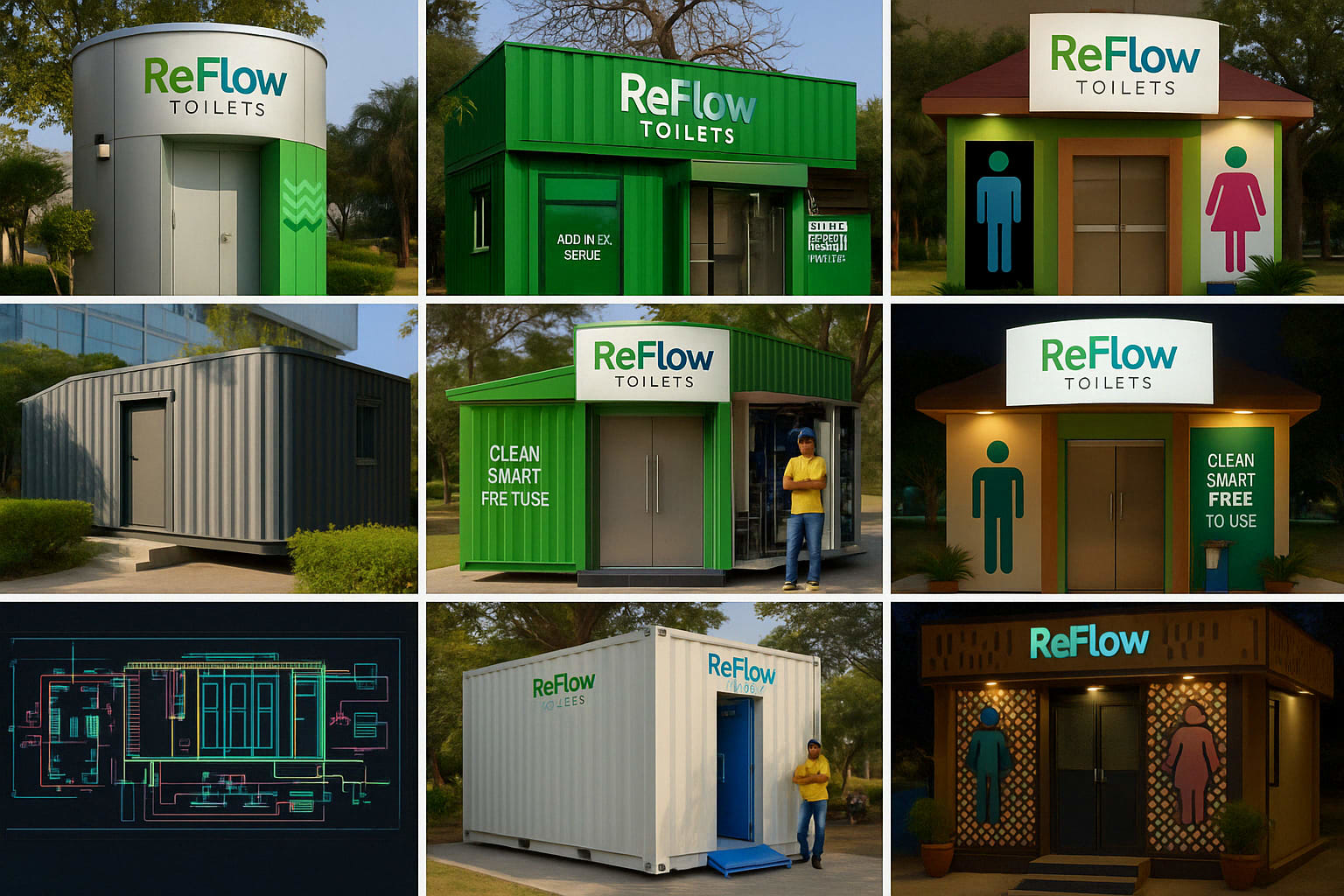
The ReFlow Evolution:
Building on LooCafe's operational proof-of-concept:
- B-CRT technology: ISO30500 compliant, zero discharge
- Government contracts: Build-Operate-Transfer model with zero upfront cost
- IoT monitoring: Real-time tracking prevents "build and forget"
- District-scale deployment: 10-100+ units per contract
The Sustainability Formula
What works:
- Design excellence (Tokyo)
- Community engagement (Sanergy)
- Privacy and safety (Scandinavia)
- Sustainable economics (LooCafe)
- Proactive maintenance (ReFlow IoT)
What fails:
- Top-down imposition without consultation (China, Bolivia)
- Technology without maintenance (Gates toilets)
- CAPEX without OPEX (global government pattern)
- Privatization without participation (Cochabamba)
- One-size-fits-all (water-flush in water-scarce areas)
Why This Is a Miracle
Consider the obstacles any WASH startup must navigate:
- 5+ government departments with conflicting mandates
- Procurement rules favoring incumbents
- Politicians preferring ribbon-cutting over maintenance
- $200M Gates Foundation still can't make affordable toilets
- Global failure rate with $1.9B in "lost" infrastructure
For a company to emerge from this landscape with:
- 270+ operating units
- INR 21.5 Cr annual revenue
- 99.2% uptime through IoT monitoring
- Sustainable business model without VC funding
- Gates Foundation partnership for G2RT deployment
This isn't just success. It's survival in an industry graveyard.
Conclusion: Bureaucracy Kills Innovation—Unless Innovation Navigates Bureaucracy
The global public toilet crisis is not a technology problem. Technologies exist. The Gates Foundation proved that with 25+ innovations.
The crisis is:
- Political (ribbon-cutting over maintenance)
- Institutional (5+ departments, no accountability)
- Economic (CAPEX bias, deferred maintenance)
- Social (dignity, privacy, community input)
ReFlow's approach addresses each:
- Political: TCO arguments that make sense over electoral cycles
- Institutional: Single point of accountability that cuts across silos
- Economic: Service contracts that bundle maintenance with construction
- Social: Community-focused deployment with IoT transparency
The public toilet crisis will continue—San Francisco will spend millions on single units, Britain will continue losing toilets, and the Gates Foundation will keep searching for breakthroughs.
But in Hyderabad, Chennai, and across India, something different is happening. A company that understands both technology and bureaucracy. A model that's self-sustaining rather than grant-dependent. A solution that actually works at scale.
That's not common in this industry. That's the miracle.
References
- San Francisco Chronicle. "S.F.'s Toiletgate: Newsom calls $1.7 million toilet 'outrageous.'" (2022)
- British Toilet Association. "The decline of the great British public toilet." (2024)
- Nippon Foundation. "The Tokyo Toilet Project." (2020-2023)
- Gates Foundation. "Reinvent the Toilet Challenge: A Brief History." (2011-2025)
- Gates Foundation. "Making reinvented toilets more affordable." (2024)
- World Bank. "Policy, Institutions, and Regulation for Water and Sanitation." (2021)
- World Bank Policy Research Working Paper 9903. "Understanding Public Spending Trends for Infrastructure." (2022)
- Global Water Partnership. "Bolivia: The Water War." (2000)
- Sanergy. "Fresh Life Toilets Kenya." (2024)
- Wikipedia. "LooCafe." (2024)
- The Better India. "Hyderabad's LooCafe." (2020)
Cross-Site Resources
This article is part of a cross-site research series examining global sanitation infrastructure challenges and solutions.
- LooCafe Companion Article: Why WASH Startups Fail - Deeper dive into LooCafe's business model
- LooCafe G2RT Technology: Gates Foundation Partnership
- ReFlow B-CRT Specifications: Technical Details - Full engineering specifications