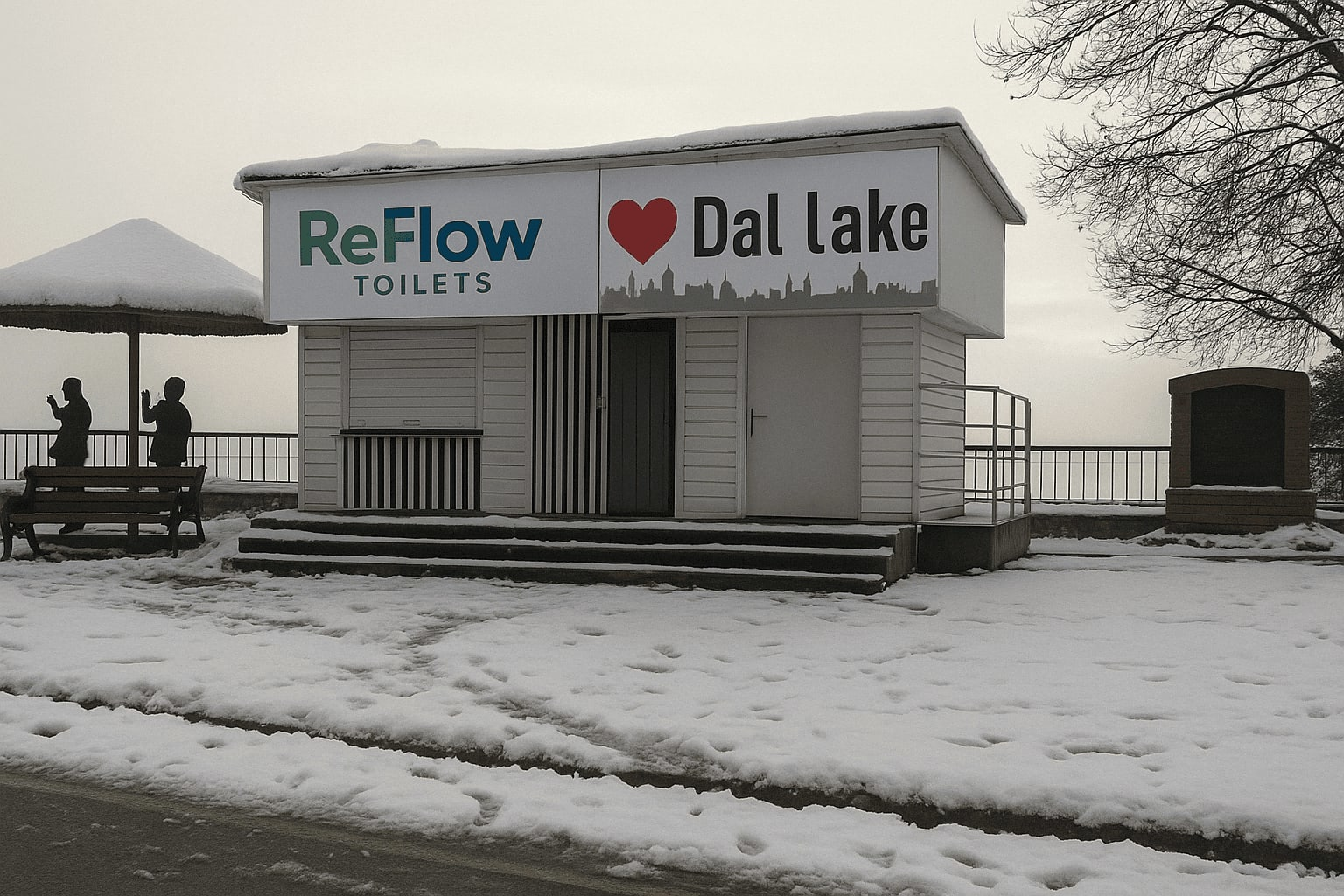
Water Crisis Solutions: Toilets That Don't Need Water Infrastructure
By 2025, two-thirds of the world's population will face water scarcity. Yet conventional sanitation systems treat fresh water as an unlimited resource, using 6-13 liters per toilet flush—often more water than many families use for drinking, cooking, and bathing combined.
This paradox lies at the heart of the global sanitation crisis: the areas with the greatest need for improved sanitation are precisely those with the least water to spare. Traditional sewered sanitation becomes economically and environmentally unsustainable in water-stressed regions.
The solution exists today: decentralized toilet systems that recycle 90%+ of water, require no municipal water supply, and treat waste to produce safe, reusable water. This technology isn't futuristic—it's operating successfully in water-scarce regions worldwide.
The Water-Sanitation Paradox
Global Water Stress
Current Crisis:
- 2.2 billion people lack safely managed drinking water (WHO/UNICEF 2021)
- 4 billion people face severe water scarcity at least one month per year
- 733 million people live in high water-stress areas
- Climate change is intensifying droughts and reducing freshwater availability
India's Water Emergency:
- 600 million Indians face high to extreme water stress (NITI Aayog 2019)
- 21 major cities projected to reach zero groundwater by 2030
- 200,000 people die annually from inadequate water access
- 70% of water supply contaminated, partly from inadequate sanitation
The Sanitation Compounding Factor:
Urban sanitation consumes 15-30% of municipal water supply. In a city of 1 million:
- Daily water demand: 150-200 million liters
- Sanitation consumption: 22.5-60 million liters (15-30%)
- Equivalent to drinking water for 1.5-4 million people
During droughts, water shortages force impossible choices: drinking water or functioning toilets? The result is often open defecation, with cascading public health consequences.
Traditional Toilets' Water Footprint
Per-Use Consumption:
Conventional flush toilets:
- Old toilets (pre-1990): 13-20 liters per flush
- Standard toilets (1990-2010): 9-13 liters
- Low-flow toilets (2010+): 6-9 liters
- Dual-flush toilets: 3-6 liters (liquid waste) / 6-9 liters (solid waste)
Daily per capita:
- Average person: 4-6 toilet visits per day
- Water consumption: 18-54 liters per person per day
- Family of 4: 72-216 liters per day
- Annual consumption: 26,280-78,840 liters per household
Public Toilets:
For a facility serving 300 users daily:
- At 6 liters per flush: 1,800 liters/day = 657,000 liters/year
- At 13 liters per flush: 3,900 liters/day = 1,423,500 liters/year
- Enough water for 30-65 people's total daily needs (WHO minimum: 50 liters/person/day)
The Infrastructure Burden
Traditional sanitation requires:
1. Water Supply Infrastructure:
- Treatment plants to produce potable-quality water
- Pumping stations for distribution
- Pipeline networks reaching every building
- Storage tanks for demand management
- Estimated cost: $500-2,000 per household connection
2. Sewerage Infrastructure:
- Collection sewers (gravity or pressurized)
- Pumping stations (every 2-5 km in flat terrain)
- Trunk sewers to treatment plants
- Wastewater treatment plants
- Effluent disposal or reuse systems
- Estimated cost: $800-3,000 per household connection
Total infrastructure: $1,300-5,000 per connection
For a city of 100,000 people (25,000 households): $32.5-125 million in infrastructure investment.
This excludes:
- Operating costs ($100-300 per household annually)
- Energy for pumping and treatment
- Maintenance and repairs
- System expansions for population growth
In water-scarce regions, this infrastructure must be built twice: once for fresh water delivery, again for wastewater removal. The capital requirement is prohibitive.
Decentralized Water-Independent Sanitation
Zero-discharge toilet systems break the water-infrastructure dependency through four key innovations:
1. Minimal Water Use
Water Consumption:
Zero-discharge systems use 0.3-0.5 liters per flush vs. 6-13 liters for conventional toilets—a 92-98% reduction.
Technology:
Vacuum-assisted flush: Creates strong siphon with minimal water volume, similar to aircraft toilets but at normal atmospheric pressure.
Optimized bowl design: Shaped to ensure complete waste removal with minimal water, using computational fluid dynamics to optimize flow patterns.
Spray rinse: Fine mist (0.1L) cleans bowl surface after solid waste removal.
Daily per-user consumption:
- 4 uses/day × 0.4L = 1.6 liters
- vs. conventional: 4 uses/day × 9L = 36 liters
- Savings: 34.4 liters per person per day (96% reduction)
For a 300-user public toilet:
- Daily water use: 480 liters (vs. 10,800 liters conventional)
- Annual use: 175,200 liters (vs. 3,942,000 liters)
- Savings: 3.77 million liters per year
2. Water Recycling
Closed-Loop System:
Zero-discharge systems recycle 85-95% of water through multi-stage treatment:
Stage 1: Solid-liquid separation captures waste, allowing liquid to proceed to treatment
Stage 2: Biological treatment (MBBR) reduces organic matter and nutrients
Stage 3: Clarification settles remaining suspended solids
Stage 4: UV disinfection eliminates pathogens
Stage 5: Membrane filtration produces crystal-clear water
Stage 6: Recycled water returns to flush tanks
Water Balance:
For a 300-user toilet:
- Daily intake (new water): 480 liters
- Treatment throughput: 2,400 liters (includes recycled water)
- Recycled water: 1,920 liters (80%)
- Water lost to:
- Evaporation: 240 liters (10%)
- Solids moisture: 192 liters (8%)
- Cleaning/maintenance: 48 liters (2%)
- Net water makeup required: 480 liters
Effective water consumption: 480 liters/day vs. 10,800 liters conventional
Savings: 95.6%
3. On-Site Water Production
Rainwater Harvesting Integration:
A 50 m² roof area above a public toilet can collect:
- Annual rainfall (Hyderabad): 800mm
- Harvestable water: 50m² × 0.8m × 0.8 (efficiency) = 32,000 liters/year
- Minus evaporation/losses: ~25,000 liters/year usable
This covers:
- 300 users × 1.6L/day = 480L/day needed
- 480L/day × 365 days = 175,200L/year needed
Rainwater alone provides 14% of annual needs. Combined with recycling (90%), the system requires only 10% external water supply—often provided by small tanker delivery (3,000L every 17 days).
Atmospheric Water Generation:
In humid climates, systems can integrate atmospheric water generators:
- Extract water from air through condensation
- Typical yield: 10-30 liters/day (depending on humidity)
- Solar-powered operation
- Provides 2-6% of daily needs as supplemental source
Greywater Integration:
Some installations capture handwashing water (sink effluent) for toilet flushing:
- 300 users × 1L handwashing = 300L/day
- After filtration: 270L/day usable
- Covers 56% of new water needs
4. Zero Infrastructure Dependency
Complete Independence:
Zero-discharge systems require NO connection to:
- Municipal water supply
- Sewerage networks
- Centralized treatment plants
Self-Contained Components:
Water supply:
- Rainwater harvesting
- Small tank storage (500-2,000L)
- Tanker delivery (occasional)
- Optional borewell (if groundwater available)
Energy:
- Solar panels (2-4 kW)
- Battery storage (optional, for night operation)
- Grid connection optional, not required
Waste management:
- On-site biological treatment
- Solids composting or thermal processing
- Periodic removal of stabilized solids (quarterly)
Result: Toilets operate in areas with zero infrastructure—refugee camps, remote communities, informal settlements, disaster zones.
Real-World Impact: Water Savings
Case Study: Hyderabad Deployment
Installation: 15 B-CRT units across Greater Hyderabad Municipal Corporation area (2022-2024)
Water Savings Data:
Annual per-unit:
- Users served: 350/day average
- Conventional water consumption (9L/flush): 1,155,000 liters/year
- Actual B-CRT consumption: 204,000 liters/year
- Savings: 951,000 liters/year per unit
Total 15 units:
- Annual savings: 14.27 million liters
- Equivalent to drinking water for 781 people for one year (WHO 50L/day standard)
- Avoided water supply cost (₹15/kL): ₹2.14 lakhs/year
- Avoided sewage treatment cost (₹1.2/kL): ₹1.03 lakhs/year
- Total annual savings: ₹3.17 lakhs
Drought Resilience:
During 2023 summer drought when municipal water supply was cut 30%:
- Conventional toilets: 8 out of 12 in test area closed due to water shortage
- B-CRT units: All 15 remained operational
- Service continuity: 100% vs. 33% for conventional
Case Study: Chennai Water Crisis (2019)
Chennai experienced "Day Zero"—complete depletion of municipal water reservoirs. The city of 10 million faced severe rationing.
Hypothetical Scenario: If 10% of Chennai's toilets (100,000 units) were zero-discharge systems:
Water Saved:
- Conventional consumption: 100,000 toilets × 180L/day = 18 million liters/day
- Zero-discharge consumption: 100,000 toilets × 9L/day = 900,000 liters/day
- Daily savings: 17.1 million liters
- Enough drinking water for 342,000 people
This represents 3.4% of Chennai's population—during a crisis where even a 1% reduction in demand had major impact.
Scaling Projections
India's 100 Largest Cities:
If 1% of public/commercial toilets converted to zero-discharge:
- Estimated toilets: 500,000 units
- Annual water savings: 476 billion liters
- Equivalent to 26 million people's annual water needs
- Avoided treatment costs: ₹714 crores
Global Impact:
2.3 billion people lack adequate sanitation. If 10% adopted zero-discharge systems:
- 230 million people served
- ~50 million toilets needed
- Annual water savings: 47 trillion liters
- Equivalent to residential water use of 2.6 billion people
Beyond Water Savings: Additional Benefits
1. Climate Resilience
Drought Protection:
Systems operate during water shortages, maintaining sanitation when it's needed most.
Flood Resilience:
No sewerage connection means no flood-induced sewage backup—a common problem when conventional systems overflow.
Temperature Independence:
Biological treatment functions across wide temperature ranges (10-45°C), suitable for diverse climates.
2. Economic Benefits
Infrastructure Savings:
- No water supply extension: ₹3-8 lakhs saved per toilet
- No sewerage connection: ₹2-8 lakhs saved
- No treatment plant capacity expansion: ₹1-3 lakhs saved (proportional)
- Total: ₹6-19 lakhs per toilet in avoided infrastructure
Operating Savings:
- Water cost: ₹15-30k/year (vs. conventional)
- Electricity: ₹0 (solar vs. ₹60-120k grid)
- Sewage charges: ₹0 (vs. ₹20-40k)
- Annual savings: ₹75-190k per toilet
3. Health Benefits
Improved Availability:
Systems remain operational during water crises, preventing reversion to open defecation.
Better Water Quality:
Reduced burden on water supply systems means better pressure and quality for drinking water.
Groundwater Protection:
No sewage infiltration from leaking pipes (30-50% of sewage leaks in aging systems).
4. Environmental Benefits
Energy Savings:
- No pumping fresh water: 0.5-1.5 kWh per 1,000 liters
- No pumping sewage: 0.3-0.8 kWh per 1,000 liters
- No treatment plant energy: 0.3-0.6 kWh per 1,000 liters
- Total: 1.1-2.9 kWh saved per 1,000 liters
For 3.77 million liters/year saved: 4,147-10,933 kWh saved
- CO₂ avoided: 2.9-7.7 tons (at 0.7 kg CO₂/kWh)
Nutrient Recovery:
Captured nitrogen and phosphorus can be used for agriculture, closing the nutrient loop.
Policy Implications
Water-Scarce Regions
Governments should:
- Mandate water-efficient sanitation in water-stressed areas
- Provide subsidies for zero-discharge systems (offset by infrastructure savings)
- Update building codes to allow decentralized sanitation
- Remove regulatory barriers requiring sewage connections
- Incentivize rainwater harvesting integrated with sanitation
Urban Planning
Cities should:
- Map water availability and prioritize decentralized sanitation in water-stressed areas
- Calculate lifecycle costs including water infrastructure in sanitation planning
- Pilot deployments in new developments to demonstrate viability
- Create separate standards for water-independent systems vs. conventional
International Development
Aid agencies should:
- Prioritize water-independent sanitation in drought-prone regions
- Fund demonstrations of zero-discharge systems in water-scarce areas
- Develop financing mechanisms that account for water savings
- Capacity building for local maintenance and operation
Conclusion
The water crisis and the sanitation crisis are interconnected. Conventional flush toilets, designed in water-abundant 19th century England, are fundamentally unsuited to 21st century water scarcity.
Zero-discharge sanitation systems offer a solution that addresses both crises simultaneously:
- Provide dignified sanitation without water infrastructure
- Reduce water consumption by 90-98%
- Eliminate sewage pollution
- Enable sanitation in areas where conventional systems are impossible
The technology is proven, field-tested, and cost-competitive. As water scarcity intensifies, water-independent sanitation will transition from innovation to necessity.
The question is not whether we can afford to deploy these systems, but whether we can afford the consequences of continuing with water-intensive conventional sanitation in a water-scarce world.
Related Resources:
- How Zero-Discharge Toilets Work
- Public Toilet Economics
- Explore B-CRT Water Recycling Technology
- Contact Us for Water-Saving Sanitation Solutions
References:
- WHO/UNICEF (2021). Progress on household drinking water, sanitation and hygiene 2000-2021.
- UN World Water Development Report (2023). "Water for Prosperity and Peace."
- NITI Aayog (2019). "Composite Water Management Index."
- Hanjra, M. A., & Qureshi, M. E. (2010). "Global water crisis and future food security in an era of climate change." Food Policy, 35(5), 365-377.
- ReFlow Toilets deployment data (2022-2024), Hyderabad, India.


